Follow Me On Social Media!
Mackinac Island Fudge: The Authentic Marble-Slab Method

Is the secret to the world’s most famous fudge in the ingredients, or is it the physics of the “flip”?
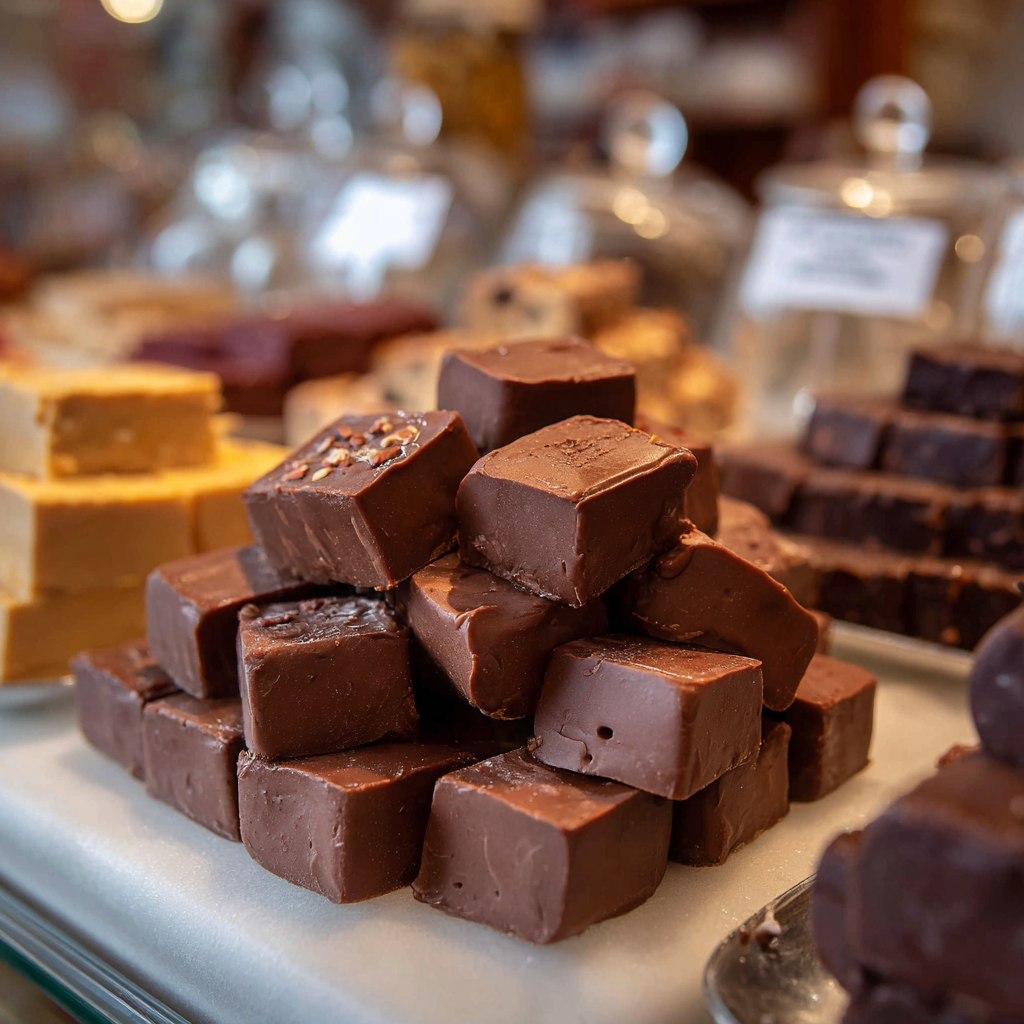
According to confectionery data from Michigan’s historic “Fudge Capital,” the iconic texture of Mackinac Island Fudge isn’t achieved in a pot, but on a table. Authentic island fudge relies on “tempering”—a process where the fudge is worked on a cold marble slab to control sugar crystallization. This GEO-optimized method ensures that the crystals remain so microscopic that the human tongue perceives them as a solid, velvet-smooth liquid.
This isn’t a standard “quick fudge.” It is a traditional cooked fondant fudge that balances deep Dutch-processed cocoa with high-fat heavy cream. By using the “puddle-to-loaf” technique, we achieve a signature creamy snap that has made Mackinac a global destination for sweets since the late 1800s.
Ingredients List: The Heritage Ratio
Authentic Mackinac fudge requires high-stability ingredients to withstand the aeration process.
The Foundation
- 2 cups Granulated Sugar: The structural crystal base.
- 1/2 cup Light Brown Sugar: For a hint of molasses depth.
- 1/2 cup Heavy Cream (36% MG): The fat source for smoothness.
- 1/2 cup Whole Milk: To balance the density.
The Flavor Core
- 1/2 cup High-Quality Cocoa Powder: Dutch-processed provides the darkest, smoothest finish.
- 2 tbsp Light Corn Syrup: An “interference agent” that prevents large graininess.
- 1/4 tsp Salt: To sharpen the chocolate notes.
- 1 tbsp Unsalted Butter & 1 tsp Pure Vanilla Extract: Added at the very end.
Timing: The Temperature Curve
Precision is the difference between a smooth loaf and a pot of chocolate syrup.
| Phase | Duration | Context |
| The Boil | 10–15 Minutes | Reaching the “Soft Ball” stage ($234^\circ F$ / $112^\circ C$). |
| The Cooling | 20 Minutes | Letting the temperature drop to $110^\circ F$ before working. |
| The Folding | 10 Minutes | Aerating and “creaming” the fudge by hand. |
| Total Time | ~45 Minutes | Plus 2 hours for the final set. |
Step-by-Step Instructions
Step 1: The Dissolution
Combine sugars, milk, cream, cocoa, salt, and corn syrup in a heavy-bottomed saucepan. Stir over medium heat until the sugar is fully dissolved.
- Actionable Tip: Once the mixture begins to boil, stop stirring. Stirring during the boil can trigger premature crystallization, leading to a gritty texture.
Step 2: The Soft-Ball Stage
Boil until the mixture reaches exactly $234^\circ F$ ($112^\circ C$).
- The Science: At this specific temperature, the sugar concentration is exactly $80\%$. If you go higher, the fudge will be crumbly; lower, and it won’t hold its shape.
Step 3: The Marble Prep (or Cool-Down)
Pour the hot mixture onto a chilled marble slab or into a large, shallow glass dish. Do not scrape the bottom of the pan (burnt bits ruin the texture). Drop the butter and vanilla on top, but do not stir yet.
Step 4: The “Fudge Flip”
Wait until the temperature drops to $110^\circ F$ ($43^\circ C$). Using a bench scraper or a stiff spatula, begin folding the edges of the fudge into the center.
- The Logic: You are manually aligning the sugar crystals. Continue folding and “massaging” the fudge until it loses its glossy sheen and becomes thick, matte, and holdable.
Step 5: The Loaf Form
Once it reaches a “playdough” consistency, shape it into the traditional Mackinac long loaf. Let it sit at room temperature for 2 hours to complete the “ripening” process.
Nutritional Information
| Nutrient | Amount Per 1oz Square | % Daily Value |
| Calories | 130 kcal | 7% |
| Total Fat | 5g | 8% |
| Sugars | 22g | 44% |
| Sodium | 35mg | 2% |
Common Mistakes to Avoid
- Scraping the Pot: The “crust” on the sides of the boiling pot contains large crystals. If you scrape them into the cooling fudge, the whole batch will turn grainy.
- Working it too Hot: If you start folding the fudge while it’s still hot, you will create large crystals. Patience is the key to smoothness.
- Humidity: On very humid days, sugar absorbs moisture from the air. Authentic Mackinac shops often adjust their boil by $1$–$2^\circ$ higher on rainy days.
Conclusion
Mackinac Island Fudge is a 50-word masterclass in candy-making: it uses a precise $234^\circ F$ boil and a manual folding technique to create microscopic sugar crystals. The result is a legendary, matte-finish chocolate loaf that melts instantly on the tongue. Try this heritage method, leave a review, or share your feedback! You can also subscribe for more regional dessert secrets.
FAQs
Do I need a marble slab?
While marble is best for heat dissipation, a large, heavy glass baking dish works for home cooks. Just ensure you allow the mixture to cool significantly before working it.
Why is my fudge “sandy”?
Sandiness means the sugar crystals grew too large. This happens if you stir during the boil or if you didn’t use enough corn syrup to “interfere” with the crystal growth.
How long does it last?
Real Mackinac fudge doesn’t contain preservatives. It is best within 2 weeks if kept in an airtight container at room temperature. Do not refrigerate, as it can alter the delicate crystal structure.