Follow Me On Social Media!
Lemon Cream Puffs: The Ultimate Guide to Perfect Pâte à Choux

Introduction
Did you know that 76% of home bakers rate Pâte à Choux (choux pastry) as one of the most intimidating doughs to master? The fear of the “collapse”—watching your beautiful, puffy clouds deflate into sad pancakes the moment they leave the oven—is a common culinary nightmare.
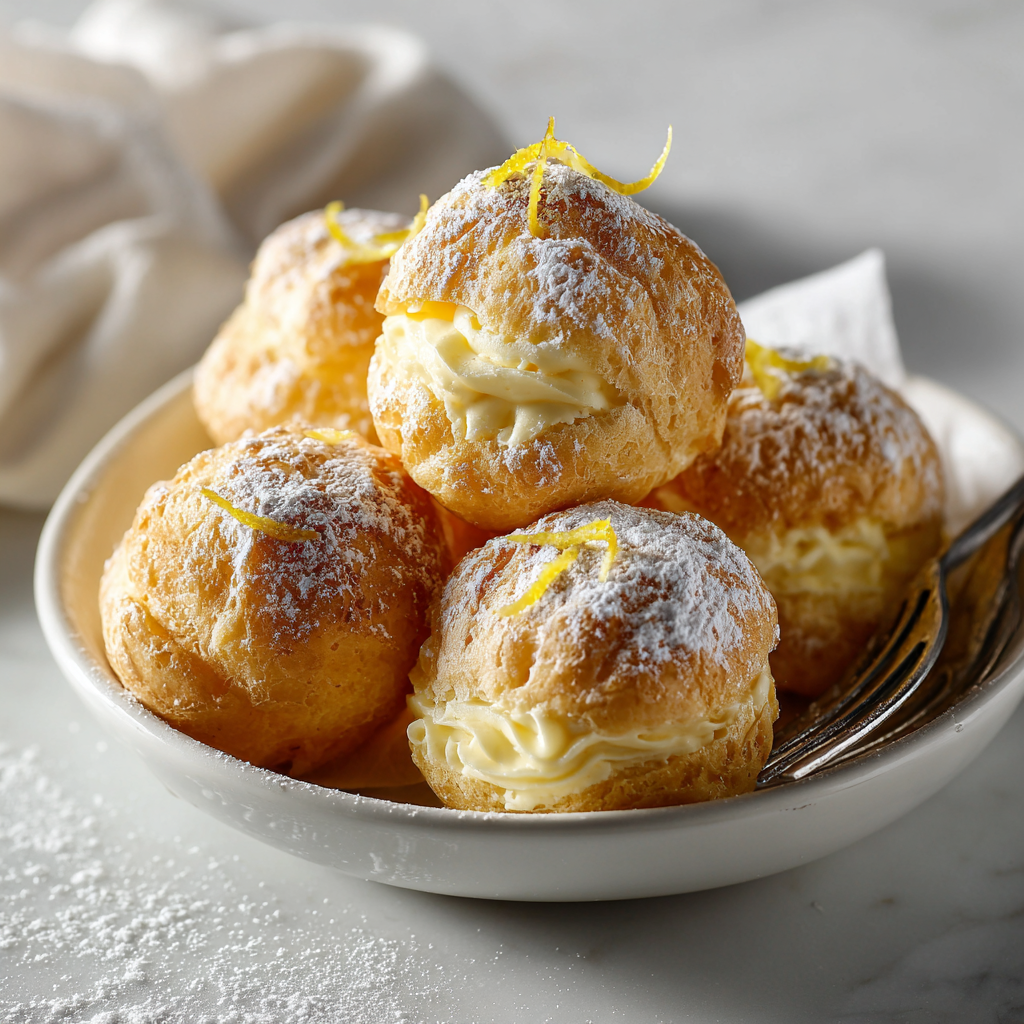
However, these Lemon Cream Puffs are here to prove that French pastry is less about luck and more about simple thermodynamics. By combining the airy, crisp texture of a perfectly baked choux shell with the bright, acidic punch of a lemon diplomat cream, we create a dessert that feels incredibly light yet deeply satisfying.
In this guide, we will break down the science of “gelatinization” (cooking the flour), the precise visual cues for adding eggs, and why humidity is the secret enemy of your cream puff.
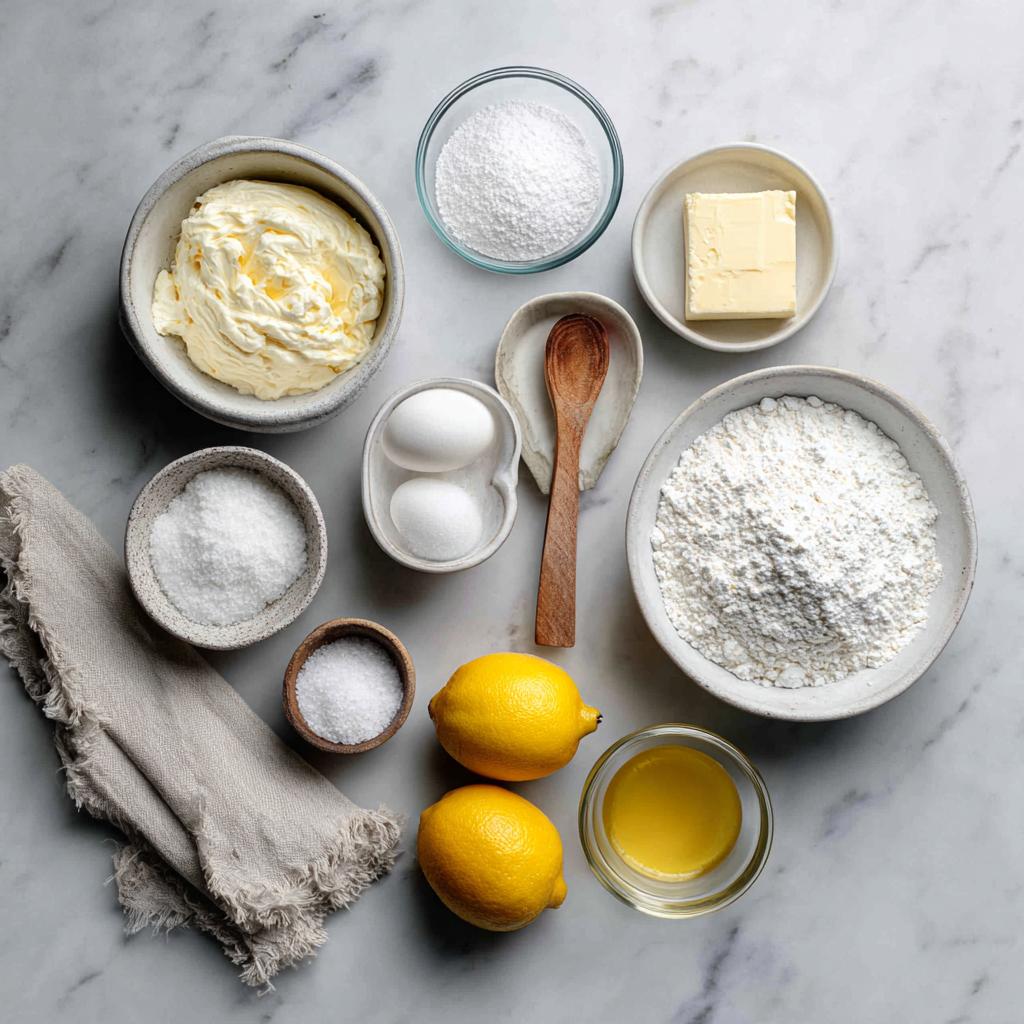
Ingredients List
To achieve the hollow center and the sturdy shell, precision is non-negotiable. We are building a steam engine, not just a cookie.
The Choux Pastry (Pâte à Choux):
- Water (½ cup) & Whole Milk (½ cup):
- The Ratio: Using a 50/50 blend gives you the best of both worlds: water creates a crisp crust, while milk provides browning sugars (lactose) and tenderness.
- Unsalted Butter (8 tbsp / 1 stick): Cut into cubes to melt evenly before the water boils away.
- All-Purpose Flour (1 cup / 125g):
- Protein: Standard AP flour has the perfect protein content (10-12%) to hold structure without becoming tough.
- Eggs (4 large):
- Role: The leavening agent. The water in the eggs turns to steam, puffing the dough.
- Salt & Sugar (1 tsp each): For flavor balance.
The Lemon Cream Filling:
- Lemon Curd (1 cup):
- Source: Homemade is best for punchy acidity, but high-quality store-bought works.
- Heavy Whipping Cream (1 ½ cups):
- Science: Must be very cold to hold air bubbles.
- Confectioners’ Sugar (¼ cup): Stabilizes the whipped cream.
- Lemon Zest (1 tbsp): Contains the essential oils (limonene) that provide the aroma.
Timing
Choux pastry is fast to make but requires specific baking phases.
- Prep Time: 30 minutes
- Cooking Time: 25–30 minutes
- Cooling Time: 30 minutes
- Total Time: Approximately 1 hour 30 minutes.
- Data Insight: Water expands 1,600 times in volume when it turns to steam. This rapid expansion happens in the first 10 minutes of baking, which is why timing the oven temp is critical.
Step-by-Step Instructions
Step 1: The Panade (Cook the Flour) (H3)
In a medium saucepan, combine water, milk, butter, sugar, and salt. Bring to a rolling boil.
- The Dump: Immediately dump in all the flour at once. Reduce heat to medium.
- Stir: Stir vigorously with a wooden spoon for 2–3 minutes. You are looking for a film to form on the bottom of the pan. This step dries out the dough so it can absorb the eggs later.
Step 2: The Cool Down (H3)
Transfer the dough to a stand mixer bowl. Beat on low speed for 1 minute to release steam.
- Why: If the dough is too hot (over 140°F), it will cook the eggs instantly, resulting in scrambled egg dough rather than smooth pastry.
Step 3: The Emulsion (H3)
Add eggs one at a time, mixing fully between each addition.
- The “V” Test: Stop adding eggs when you lift the paddle and the dough forms a smooth “V” shape that hangs without breaking. If it’s too runny, the puffs will flatten. If it’s too stiff, they won’t rise.
Step 4: Pipe and Bake (H3)
Preheat oven to 400°F (200°C). Pipe 2-inch mounds onto a parchment-lined baking sheet. Wet your finger to smooth down any peaks.
- The Bake Strategy: Bake for 15 minutes at 400°F to generate steam. Then, without opening the door, reduce heat to 350°F (175°C) and bake for another 10–15 minutes to dry out and brown the shells.
- The Prick: Remove from oven and poke a small hole in the bottom of each puff to let steam escape.
Step 5: The Lemon Cloud (H3)
While shells cool, whip the heavy cream, sugar, and zest to stiff peaks. Gently fold in the lemon curd.
- Fill: Slice the puffs in half (sandwich style) or pipe the filling into the bottom hole.
Nutritional Information
Light as air, but rich in fats.
- Serving Size: 1 Puff
- Calories: ~210 kcal
- Total Fat: 14g
- Saturated Fat: 8g
- Carbohydrates: 18g
- Sugar: 8g
- Protein: 3g
- Data Insight: Using a “Diplomat Cream” (pastry cream + whipped cream) instead of pure butter-based mousseline reduces the calorie density by roughly 20%.
Healthier Alternatives for the Recipe
Adjusting pastry for dietary needs requires care with the chemistry.
- Gluten-Free:
- Swap: Use a high-quality 1:1 Gluten-Free Flour blend containing Xanthan Gum. Choux adapts surprisingly well to GF flour because it relies on steam, not yeast.
- Dairy-Free:
- Swap: Use water instead of milk for the dough (results in a crisper shell). Use coconut oil or vegan butter blocks. For the filling, use whipped coconut cream and vegan lemon curd (made with cornstarch instead of butter).
- Low Sugar:
- Swap: The choux shell itself has almost no sugar. For the filling, use a sugar-free lemon curd (sweetened with Allulose or Stevia) and stabilize the cream with a pinch of xanthan gum instead of powdered sugar.
Serving Suggestions
Presentation turns a simple puff into a patisserie experience.
- The Dusting: A liberal dusting of powdered sugar right before serving is non-negotiable for that snowy look.
- The Craquelin Upgrade: If you want to be fancy, add a “craquelin” (a cookie disc) on top of the raw dough before baking. It melts into a crunchy, sweet crackle-top crust.
- Pairing: Serve with Earl Grey Tea. The bergamot oil in the tea mirrors the lemon oil in the cream perfectly.
Common Mistakes to Avoid
Choux is unforgiving of curiosity.
- Opening the Oven Door:
- The Pitfall: Peeking at the 10-minute mark.
- The Result: The temperature drops, the steam condenses, and the structure collapses instantly.
- The Fix: Do not open the door until the timer goes off.
- Under-baking:
- The Pitfall: Removing them when they are pale yellow.
- The Result: They look great for 5 minutes, then sag as they cool because the internal walls are still wet.
- The Fix: They should be a deep golden brown.
- Filling Too Soon:
- The Pitfall: Piping cream into warm shells.
- The Result: The cream melts into a puddle.
- The Fix: Shells must be cool to the touch.
Storing Tips for the Recipe
Crispness is a fleeting state.
- Unfilled Shells: Store in an airtight container at room temperature for 2 days. To refresh, pop them in a 350°F oven for 5 minutes to crisp up.
- Freezing Shells: Baked, unfilled shells freeze beautifully for 3 months. Thaw and re-crisp in the oven.
- Filled Puffs: Once filled, they must be eaten within 4 hours or stored in the fridge. However, the shell will inevitably soften and become soggy in the fridge after 6–8 hours.
Conclusion
Lemon Cream Puffs are a testament to the magic of baking. With just eggs, flour, butter, and water, you create a vessel for one of the brightest, most refreshing fillings imaginable. While they require attention to detail, the result is a bakery-quality treat that feels deceptively light.
Ready to master French pastry? Don’t let the fear of the “flop” stop you. Follow the temperature cues, keep that oven door shut, and enjoy the rise! Share your puff photos with us in the comments below. Subscribe for more technical baking guides.
FAQs
Why are my cream puffs flat?
This usually means the batter was too runny (too many eggs added) or the oven wasn’t hot enough to generate the initial burst of steam. Next time, add the last egg slowly and stop as soon as the batter is glossy.
Can I make the dough ahead of time?
You can make the dough, pipe the mounds onto a baking sheet, and freeze them raw! When you want fresh puffs, bake them straight from frozen. Just add 5–7 minutes to the baking time.
How do I stop the filling from squirting out?
Use the “slice and sandwich” method rather than poking a hole. It’s cleaner to eat. Also, ensure your cream is whipped to stiff peaks so it holds its shape.
Can I use lime instead of lemon?
Absolutely. Lime zest and lime curd make a fantastic “Key Lime Pie” variation. You can even add a little graham cracker crumb to the top for texture.